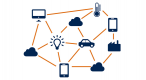
Unlike many other technologies, the Internet of Things (IoT) is significantly more complex, spanning nearly every branch of core engineering including Mechanical, Electronics, Firmware, Middleware, Cloud, Analytics, and Mobile. Each engineering layer of IoT involves critical considerations of economics, standards, regulations, and the evolving state of the art. For the first time, this modest course offers a comprehensive coverage of these essential aspects of IoT Engineering.
Summary
An advanced training program that explores the current state of the art in the Internet of Things.
Crosses multiple technology domains to build awareness of IoT systems, their components, and how they can drive efficiency for businesses and organizations.
Features live demonstrations of model IoT applications to showcase practical deployments across various industry sectors, such as Industrial IoT, Smart Cities, Retail, Travel & Transportation, and use cases involving connected devices and things.
Target Audience
Managers responsible for business and operational processes within their organizations who wish to understand how to leverage IoT to enhance system and process efficiency.
Entrepreneurs and Investors seeking to build new ventures and aiming to develop a deeper understanding of the IoT technology landscape to effectively leverage its potential.
Estimates for the Internet of Things (IoT) market value are massive, as the IoT is defined as an integrated and diffused layer of devices, sensors, and computing power that overlays consumer, business-to-business, and government industries. The IoT is projected to account for an increasingly vast number of connections: 1.9 billion devices today, rising to 9 billion by 2018. That year, the number of IoT connections will be roughly equal to the combined total of smartphones, smart TVs, tablets, wearable computers, and PCs.
In the consumer space, numerous products and services have already transitioned into the IoT ecosystem, including kitchen and home appliances, parking solutions, RFID, lighting and heating products, and various applications within the Industrial Internet.
However, the underlying technologies of IoT are not entirely new, as Machine-to-Machine (M2M) communication has existed since the birth of the Internet. What has changed in the last few years is the emergence of numerous inexpensive wireless technologies, driven by the overwhelming adoption of smartphones and tablets in every home. The explosive growth of mobile devices has led to the current demand for IoT.
Due to the unbounded opportunities in the IoT business sector, a large number of small and medium-sized entrepreneurs have joined the IoT gold rush. Additionally, the emergence of open-source electronics and IoT platforms has made the cost of developing IoT systems and managing their significant production increasingly affordable. Existing electronic product owners are now experiencing pressure to integrate their devices with the Internet or mobile apps.
This training is designed to provide a technology and business review of this emerging industry, enabling IoT enthusiasts and entrepreneurs to grasp the basics of IoT technology and business models.
Course Objective
The main objective of the course is to introduce emerging technological options, platforms, and case studies of IoT implementation in home & city automation (smart homes and cities), the Industrial Internet, healthcare, government, mobile cellular networks, and other areas.
Provide a basic introduction to all elements of IoT, including Mechanical systems, Electronics/sensor platforms, Wireless and wireline protocols, Mobile to Electronics integration, Mobile to enterprise integration, Data analytics, and the Total control plane.
Explore M2M Wireless protocols for IoT, such as WiFi, Zigbee/Zwave, Bluetooth, and ANT+, discussing when and where to utilize each one.
Examine Mobile/Desktop/Web apps for registration, data acquisition, and control, along with available M2M data acquisition platforms for IoT such as Xively, Omega, and NovoTech.
Address security issues and security solutions for IoT.
Review open-source/commercial electronics platforms for IoT, including Raspberry Pi, Arduino, and ArmMbedLPC.
Discuss open-source/commercial enterprise cloud platforms for AWS-IoT apps, Azure-IoT, Watson-IoT, in addition to other minor IoT clouds.
Study the business and technology aspects of common IoT devices, such as home automation, smoke alarms, vehicles, military applications, and home health.
Read more...